The Big Picture

Imagine for a moment the following possible future for our city: Every neighborhood has thriving hubs of urban agriculture, sourcing organic materials and “waste” products back into the growing of healthy and economically accessible food. Where once there were vacant lots or barren weedy fields of grass, mature forest gardens now thrive providing fruit, vegetables, flowers, fibers, wood, and other materials to neighbors; people walk from their homes—surrounded by flowers and home garden plots, perhaps with chickens scratching about here and there—and gather in their neighborhood food forest, enjoying picnics, playing music, incorporating green spaces into everyday life. Children play freely and safely in rich ecosystems filled with edible foods and an abundance of living things, even within dense urban neighborhoods. City dwellers are connected to food producers in the rural hinterland, where farmers raise livestock in silvopasture and regeneratively managed fields; flows of energy and resources move between city and countryside; trails and rails connect valley and mountain and ridge, and homes and businesses and organizations harvest sunlight and harness the wind, surrounded with garden plots and pollinator meadows, trees providing shade, beauty, and food.
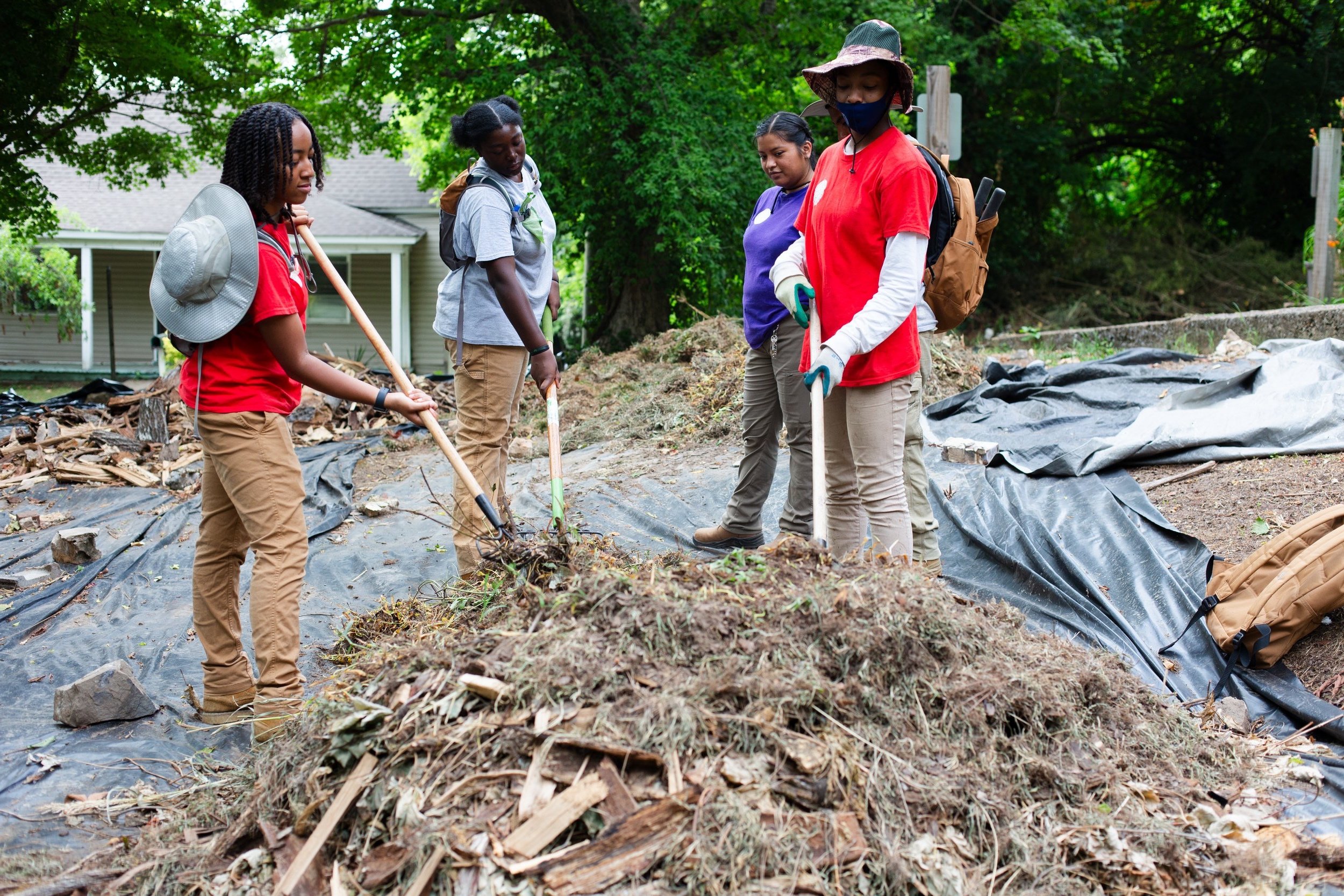
The Food Forest Coalition of Chattanooga is working to realize here-and-now aspects of just such a vision, starting with the building of community-supported forest gardens on a small scale.


Our Mission
Uniting a network of community-owned food forests as a resource for learning, long-term strategic planning, and communal design.

Our Community Approach
We are here for you! To be a resource in-person and online for learning, establishing, and growing your food forest. Helping you piece together the necessities for your food forest and connected community to thrive across seasons and generations.
-
Southern Chattanooga severely lacks accessible green spaces, with even fewer high-quality ecologically and socially rich green spaces. Only a handful of public parks are located in these neighborhoods (and in adjacent Rossville), and those that do exist have limited facilities.
Food forests can be de facto public parks, providing different recreational, meeting, and gathering spaces. This gives residents a different park experience than the standard model of closely clipped grass fields with a few trees and landscaping.
As dynamic places, food forests offer new experiences and sights to neighbors as they mature, re-imagining under-utilized spaces as solutions to expressed community needs and desires.
-
Perhaps the most central goal of any food forest is to provide perennial food– fruit, vegetables, nuts, mushrooms, edible flowers, and herbs for culinary and medicinal purposes. While no single food forest will solve systemic food access, it can provide healthy and sovereign produce to underresourced food-insecure communities. Food forests begin to address systemic problems as anchor sites for other activities and initiatives. Food forests can be designed to encourage communities to expand diversity within their food nutrient sources through markets or urban foraging.
-
The under-resourced neighborhoods of Chattanooga are some of the most diverse in our region, with a wide variability in terms of income gradient, languages spoken at home, and socio-cultural backgrounds. Bringing different distinct communities together over the shared issue of access to and use of the land is a potentially powerful way of mitigating social stresses and bridging divides. Community food forests act as a starting point, building equity and access, giving power and resource allocation to the people who inhabit these neighborhoods and who will tend and enjoy the fruits of the land.
A central goal is to assist communities in ensuring land used for urban agriculture and ecological restoration remains in the long-term trust of the communities who use these spaces. This is integral in avoiding potential displacement and gentrification in the future.
-
While there are many vacant lots and riverine corridors throughout southern Chattanooga neighborhoods, it is worth noting that mere lack of use does not automatically equal robust ecological dynamics or resulting ecological services such as support of pollinators, rebuilding of soil, filtration of water and air, or support of other forms of urban wildlife and biodiversity.
As is true virtually everywhere in the twenty-first century, aggressive species are a constant presence, frequently overwhelming unmanaged natural spaces, preventing the formation of subsequent ecological assemblies absent human intervention. Food forests act as anchors and refugium for ecological restoration, both active and passive, providing robust and diverse ecological services simultaneous to and convergent with the food, social, and other human benefits.
-
Individual/Household
Our overall coordinating organization builds relationships to connect with local households, particularly those of lower-income residents interested in gardening, permaculture, home-scale food forests, and food preservation. Through, hands-on teaching and facilitating peer-to-peer instruction that would help small-scale producers increase yields, households conserve energy and better store and utilize food, how to safely and effectively forage urban wild plants for food and medical uses, etc.
Public Spaces
In Public spaces, with preambulatory teaching from diverse instructors, drawing upon local gardeners and producers, we focus on cultivating individual household and neighborhood public spaces in ecologically sensitive ways conducive to restoring habitat congruent with human needs and capabilities. Communal learning includes historical ecological systems and their plant and animal assemblies native to our region.
Regional Context
We would integrate a historical awareness of agriculture and ecology in our region through communal earning and site signage
-
A century of heavy industry left many Chattanooga soils and waters polluted in deep and persistent ways. While mild improvement has occurred in recent decades, many pollutants persist, some industrial, others found in many city lots, such as lead derived from paint.
Food forests provide a way to grow healthy food with minimal or no effect from such pollutants. They can be designed to remediate and heal polluted soils and waterways and prevent future routes of pollution through control of runoff, reduction of pesticides/herbicides, and routing landfill-destined materials into compost and other uses.
In confronting anthropogenic climate change, the benefits are somewhat more abstract: the gardens sequester carbon, though given their urban lot size, this direct benefit is minimal. Likewise, the cessation of things like fossil fuel-powered grass cutting has small climate benefits on a micro scale, while localized food production can help to reduce methane-producing food waste and vehicular transport.
More significantly, the formation of local green spaces that act as in-neighborhood destinations and anchors can encourage reduced vehicle use and more localized forms of production, education, recreation, and the like, building-blocks in developing infrastructure far less dependent on fossil fuel use. Bringing residents into closer contact with living ecosystems from which they directly and tangibly benefit in the form of fresh food and enjoyable green spaces is also vital in encouraging individual and community investment in other solutions, in highlighting the value that healthy food and ecological systems have for all of us.
-
Home-scale agriculture is already practiced by many people in Chattanooga communities, in particular in southern neighborhoods. This project will bring together home-scale producers and share expertise, seed stock, and resources, directly providing perennial plants.
Perennial fruit bearing plants are generally fairly expensive when purchased from nurseries, which can be a real impediment for lower income residents; plus not everyone in our neighborhoods has easy access to motorized vehicles, nor is the knowledge necessary for grafting widespread.
LOCAL CONTEXT
The human history of this landscape is as diverse as the ecological landscape and has encompassed various Indigenous peoples as well as, in more recent years, people from all over the earth, each bringing new species of food-bearing plants to our region, many of which we can incorporate into our food forest installations. One of the goals of this coalition is to incorporate that rich human history and present, drawing upon the agricultural traditions represented by the residents of these neighborhoods and reflecting indigenous practices that were once a part of the landscape.
Our Origin Story
Why Chattanooga
The Food Forest Coalition of Chattanooga began as an idea in the summer of 2023 and has since grown into a group of people committed to realizing a vision of community foods forests - also known as forest gardens - across our city and surrounding metro area. By the spring of 2024, we began collaborating with 5 different sites. See our Community Map to learn more!
Our long-term goal is to see community-owned and supported forest gardens in neighborhoods throughout the city, while also encouraging homeowners, renters, and other organizations to pursue more productive and ecologically sound forms of land use, with our forest garden sites as inspiration and incubators for further growth.
This Chattanooga network of food forests crosses a diverse landscape encompassing several distinct human and natural ecologies and embracing a wide range of communities, from the relatively affluent to some of the most systemically disadvantaged in our metropolitan area. Our western anchor will be on the slopes of Lookout Mountain, the eastern anchor in the shadow of Missionary Ridge, with sites located on mountain slopes and in the limestone valley bottoms between the ridges.
Historically this landscape would have featured a mosaic of ecosystems of varying degrees of human presence and intervention; remnants of historic ecosystems remain scattered around the metro area and will provide reference points for our food forest development, as will the long history of human occupation and agriculture, from the Woodland Period to the present.
These are also landscapes with troubled troubled human histories: most immediately for our purposes, the land carries the traces of heavy industry and its pollution, with various substances remaining present in the soil and the water long after the culprits closed down and shipped away. One of the advantages of the food forest model is the fact that perennial agriculture is on the whole better suited for soil remediation, and carries much less risk to human health, than a lot of annual vegetable production models; whereas in many of the available pieces of land raised beds or extensive soil remediation would be necessary, a food forest can work with higher levels of contamination without passing them on to human consumers.
These neighborhoods are also marked by the long legacies of racism, various forms of violence and social disorder, and other legacies that have shaped our city and with which we must continue to grapple. Crucially, our goal is for this project to incorporate all of the residents of these neighborhoods so as to strengthen the communities around them. Direct community participation and decision making is crucial to realizing such a vision, with the support and guidance in particular of existing community structures such as churches, libraries, locally owned businesses, neighborhood groups and associations, and the like being especially important.

Map
JOIN THE COMMUNITY

Social Media

Events

Volunteer

Donate